Ground protection when using a mini digger is what stands between a job that leaves a garden looking much as it did and one that finishes with a rutted lawn, a scuffed drive and a cracked inspection cover to put right. It matters far more on domestic work than on an open site, because almost every surface a machine has to cross at a house is a finished one that somebody paid for. What follows covers the three things you are actually protecting, the boards and mats that spread a machine’s weight, how each drive surface behaves, the drains and covers sitting under a driveway, the tighter rules that apply around protected trees, and why choosing the lightest machine that will do the work does as much good as anything you lay on the ground.
Most people picture the grass when they think about protecting the ground, but there are three separate layers to think about and they need different answers.
The first is the surface you can see, so turf, tarmac, block paving, resin bound gravel or concrete. The second is everything buried beneath it, which on a typical property means drain runs, inspection chambers, water and gas services, soakaways and sometimes a septic tank. The third is the soil structure itself, which gets compacted by repeated loading and stays compacted long after the tracks have gone.
Central Plant Hire’s own FAQs make the buried services point clearly. “You need to check for underground obstructions and services such as gas, electricity, water and telephone before starting any excavation. Even a small mini digger will damage these services.” Finding out where those runs are before anything gets delivered is the first piece of ground protection on any job, and it costs nothing but a phone call and a look at the drainage plan.

Ground damage is a pressure problem rather than a weight problem, and a board works by taking the load off a narrow strip and spreading it across a wider footprint. Put a machine’s track straight onto wet turf and the whole load is carried by two strips of ground. Put a run of boards underneath and the same load is shared across several times the area, which is usually enough to keep the surface intact.
Exterior grade plywood, scaffold boards and proprietary plastic or composite mats all work on that same principle, with the heavier products spreading load over a bigger area and standing up to more passes. Whichever you use, a few rules apply to all of them.
That fourth point is where most ground protection when using a mini digger falls down. A tracked machine steers by driving one track faster than the other, and that scrubbing action is what tears turf and pulls the sand out of block paving joints. A board that slides sideways under a turning machine protects nothing. Plan one line in and one line out, and do your turning on hardstanding or on ground you are about to dig up anyway.
Ground protection when using a mini digger on a lawn is really about water. Saturated soil has nowhere to go when it is loaded, so it displaces sideways and compacts, and that is what leaves a rut. The same ground that carries a machine without complaint in August can mark under the smallest machine in February.
If the job can wait a couple of dry days after heavy rain, waiting is the cheapest ground protection there is. If it cannot, board the route. It is also worth remembering that the digger is often not the machine doing the damage. A loaded dumper making the same trip twenty times over the same strip of grass will rut a lawn long before a digger parked on its slew ring will.
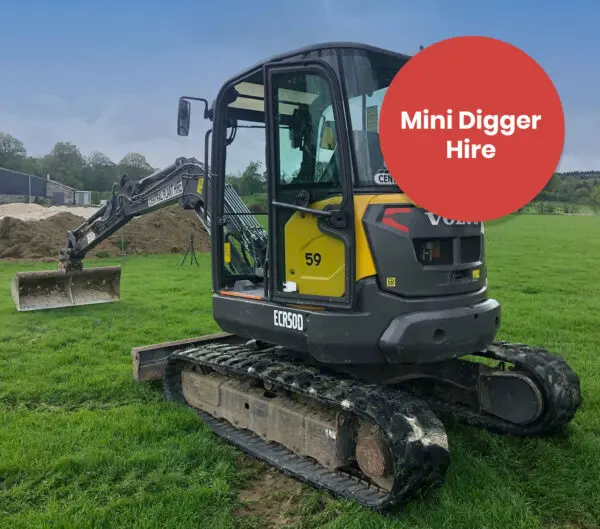
Tarmac is the surface Central Plant Hire flags most often, and their FAQs give the reason. “All our mini diggers (1 to 5 ton) are on rubber tracks to save damage on block paving or tarmac. However in hot weather tarmac can become soft, so it may be advisable to put boarding down to protect it.” A warm afternoon is enough to soften an older surface, so on a hot week the boards go down whether the ground is dry or not.
Block paving holds up well where the edge restraints are sound, its weak points being the edges and the joints. Resin bound surfaces are tough but laid thin over a base, so they follow whatever the base does. Concrete is usually the least troublesome, with thin or already cracked slabs being the exception. There is more detail on all four surfaces in our guide to whether a mini digger will damage your lawn or driveway.
This is the part of ground protection that gets missed, because the cover looks solid and sits flush with the drive. Manhole and inspection covers sold in the UK are tested to BS EN 124 load classes, and the class tells you what the cover was built to take.
| Class | Test load | Intended for |
|---|---|---|
| A15 | 15kN | Pedestrian areas |
| B125 | 125kN | Driveways, car parks |
| C250 | 250kN | Forecourts, slow traffic |
| D400 | 400kN | Carriageways |
The classes describe what a cover was built for rather than setting a vehicle weight limit, and that distinction is the useful part. A15 is specified for areas where only pedestrians have access, so a cover in that class was never intended to take plant at all, whatever the machine happens to weigh. B125 is the class specified for driveways and car parks, where occasional vehicle access is expected. Since our micro digger weighs 850kg, the 1.5 tonne 1,500kg and the 3 tonne 2,900kg, none of them belong on a cover built for foot traffic.
Working out which class a given cover is usually means lifting it and looking for the marking cast into it. Where you cannot tell, treat it as the lower class and protect it.
The fix is simple. Walk the route first, note every cover and gully grating on it, and either route around them or bridge them with a board long enough to reach sound ground at both ends. Plastic inspection chambers in particular do not give much warning before they go.
Around protected trees, ground protection stops being a matter of preference. BS 5837:2012, the British Standard covering trees in relation to design, demolition and construction, recommends that retained trees are protected by fencing and ground protection before any demolition, development or soil stripping starts, and that the protected area is then left alone. The standard is clear about why. The objective of ground protection is to avoid soil compaction and the harm that compaction does to root function, which is not something you can see happening and not something that repairs itself.
If a tree on or near the working area carries a Tree Preservation Order, sits in a conservation area, or is covered by a planning condition referring to BS 5837, the ground protection specification is usually set out by the council’s tree officer or the project arboriculturist rather than left to the person doing the digging. Check before the machine arrives rather than after.
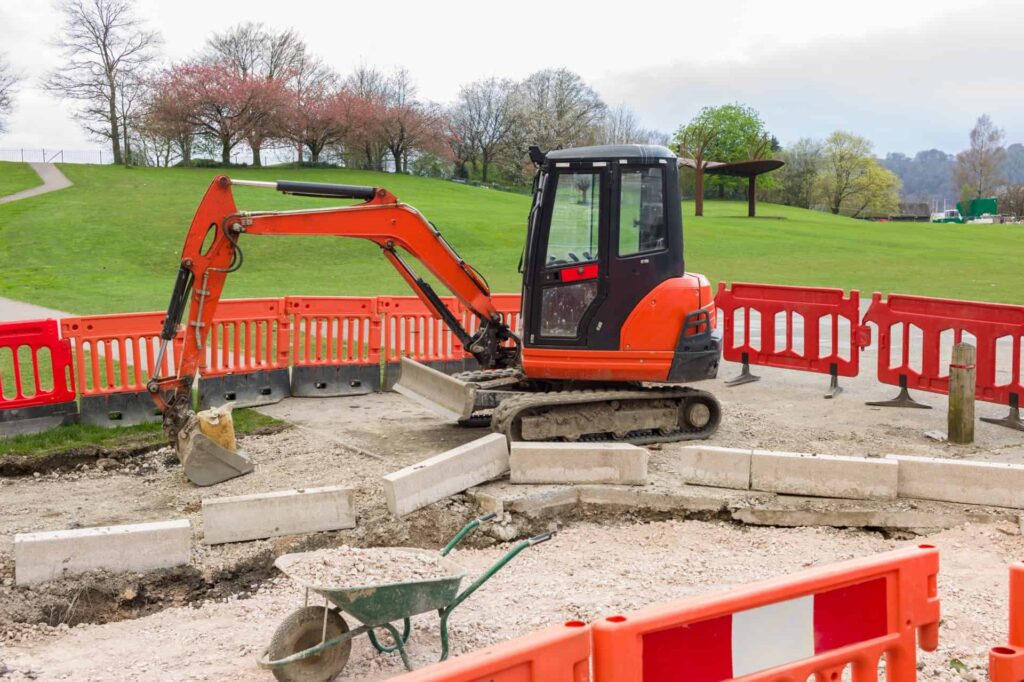
The route from the lorry to the working area is where a surprising amount of damage happens, because it is the bit nobody plans. Gateway widths decide a lot of it. Our tracked barrows are 750mm wide and the 1 tonne Thwaites skip loading dumper is 1,115mm, so on a tight access the smaller machine keeps you off the flowerbeds simply by fitting down the path.
If the only way onto the property crosses a grass verge or a footway without a vehicle crossing, that is not your ground to protect. Vehicle crossings over footways and verges are controlled by the local highway authority under section 184 of the Highways Act 1980, so a call to the council comes before anything is driven over a kerb.
Ground protection when using a mini digger starts with machine choice, because everything you lay on the ground is compensating for weight you chose to put on it. Our fleet runs from the 850kg micro digger up through the 1.5 tonne at 1,500kg, the 3 tonne at 2,900kg and the 5 tonne at 5,100kg, and the jump between the smallest and the largest is around six times the weight.
It is worth applying the same thinking to the machine moving the muck. Our 1 tonne skip loading dumper weighs 1,295kg empty and carries up to 1,000kg, while the 3 tonne dumper weighs 2,260kg empty and carries up to 3,000kg. Loaded, that is well over five tonnes crossing the lawn on every trip, which makes the dumper, not the digger, the machine to think hardest about on a finished surface.
Ground protection when using a mini digger comes down to a short list in the end. Know where the services and drains run, board the route on soft ground or hot tarmac, bridge or avoid every inspection cover, take advice from the council where protected trees are involved, and hire the smallest machine that will still do the digging. Get those five right and most gardens come through a week of groundwork with nothing to put back.
Ground protection when using a mini digger is also something our team is happy to talk through before you book, particularly if you are unsure whether your access and your ground suit the machine you had in mind. Call Central Plant Hire on 01293 851320, or take a look at our full mini digger hire range for weights and dimensions across the fleet.
