Whether you need a licence to drive a dumper depends almost entirely on where you are driving it. On private land there is no driving licence requirement in law, because driver licensing applies to the public road. On a commercial site the site rules take over and a competence card is usually non negotiable. And the moment a dumper’s wheels touch a public road, it stops being site plant and becomes a road vehicle with everything that goes with it. The sections below work through each of those three situations, explain what the law does actually require of anyone putting a person on a dumper, cover the card schemes by name, and look at the one safety rule that matters more than all the paperwork put together.
There is no licence to drive a dumper on private land, for the straightforward reason that UK driver licensing law bites on driving on a road. A dumper working inside a garden, a farmyard or a closed site is not on a road, so no DVLA licence category applies to it and nobody is going to ask to see your card.
Central Plant Hire’s own FAQs put the same position for the diggers we hire. “No, there is no legal requirement for an operator to hold a licence, however, most construction sites will require an operator to have a certificate such as the CPCS or CMPE before they are allowed to work on that site.” That second half of the sentence is where most of the confusion comes from, and it is worth separating the two ideas. A legal licence and a site competence card are different things, issued by different bodies, for different reasons.

No licence does not mean no duties. Where a dumper is being used at work, the Provision and Use of Work Equipment Regulations 1998 place a clear obligation on employers. Regulation 9 requires them to ensure that all persons who use work equipment have received adequate training for the purposes of health and safety, and the HSE is explicit that what counts as adequate depends on the job, the worker’s existing competence, the level of supervision and the equipment itself.
The HSE’s guidance on dumpers sets out what that looks like in practice. “Employers must assess the competence of those involved in dumper operations.” Drivers should be “trained, competent and authorised to operate the specific dumper”, and note the word specific, because familiarity with one machine does not automatically carry across to another. Pedestrians working around dumpers need instructing too, and the HSE states plainly that “the law says you must organise your site to segregate pedestrians and dumpers.”
Put another way, the question on a working site is not really whether you need a licence to drive a dumper. It is whether you can show that whoever is sitting in the seat has been trained on that machine and knows what they are doing.
On a commercial site the principal contractor will almost always ask for a card, and the two recognised schemes are CPCS, the Construction Plant Competence Scheme, and NPORS, the National Plant Operators Registration Scheme. Both cover dumpers under their own category codes.
These are competency certifications rather than licences in the legal sense. Site controllers ask for them because construction health and safety law makes them responsible for operator competence, and a card from a recognised scheme is the usual way of evidencing it.
They are not the whole story either. The industry’s own guidance on the safe use of dumpers, published by the Strategic Forum Plant Safety Group and hosted by the Construction Plant-hire Association, is blunt about it. “An industry certification card does not mean that the holder has the necessary competence (skills, knowledge, training and experience) to carry out their role for every task.” The same guidance stresses that “product-specific training and familiarisation of operators is essential as there are significant differences between different manufacturers and models of dumper.”
For a homeowner doing work on their own land, the position is the simplest of the three. No licence to drive a dumper is required, no card is required, and the competence card regime that governs construction sites does not reach into a private garden in the same way.
What has not gone away is the machine. A 1 tonne dumper loaded to capacity weighs well over two tonnes and behaves nothing like a car. We run through the controls and the safe operation of every machine when it is delivered, and there is an operator’s manual with it, and both are worth your full attention before you start moving material. Take a few minutes on open, level ground to get a feel for the steering and the brakes before you go anywhere near a slope, a trench edge or anyone else working on the job.
The answer changes completely the moment a dumper leaves the site. On a public road a dumper is a motor vehicle, which brings registration, vehicle tax, insurance, lighting and construction requirements into play, and the driver needs the DVLA licence category appropriate to that vehicle. The driving licence categories are set by weight and vehicle type, with category B covering vehicles up to 3,500kg maximum authorised mass, category C1 covering 3,500kg to 7,500kg and category H covering tracked vehicles.
In practice, most site dumpers are simply not built for the road. They are not registered, they have no road lighting and they are not designed for road speeds. The industry guidance even points out that a dumper fitted with a green beacon and taken onto the public highway “infringes the Road Vehicles Lighting Regulations (1989)”. The sensible answer is the one almost everyone reaches, which is that the machine travels on a lorry or a trailer and drives only on site. Our delivery covers that end of it, with rates published on our delivery page and transport charged each way.

If you take one thing from all of this, take this. The HSE reports that over 60% of dumper deaths involve the driver being crushed when the vehicle overturns, and that most of the remaining deaths happen when pedestrians are struck by a moving dumper. Its instruction to sites is to “check that dumpers are provided with roll-over protection and that drivers use their seatbelts.”
The Strategic Forum guidance explains exactly why the two go together. “A ROPS will only provide protection to the operator if the dumper’s seat belt is fastened, adjusted correctly and worn by the dumper operator during all working activities.” A roll over protection structure keeps a survivable gap around the seat when a machine goes over. The belt is what keeps the operator inside that gap. One without the other does very little.
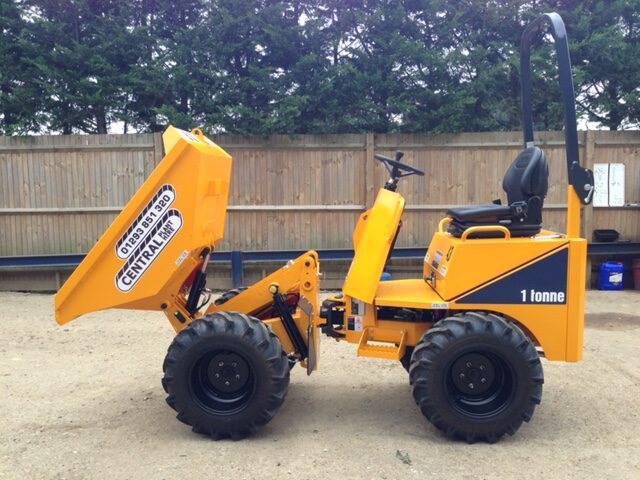
Both our 1 tonne skip loading dumper and our 3 tonne dumper are fitted with folding ROPS frames. Fold the frame down only where headroom leaves you no choice, put it back up as soon as you are through, and wear the belt whenever the machine is moving.
Most of the anxiety about needing a licence to drive a dumper disappears once people realise the real decision is which machine suits the job and the access.
Our 1 tonne Thwaites skip loading dumper is 1,115mm wide and 1,295kg unloaded, carries up to 1,000kg and lifts its skip high enough to tip straight into a builder’s skip or a low tipper. The 3 tonne dumper is 1,950mm wide and 2,260kg unloaded, carries up to 3,000kg and suits open sites and bigger volumes. Where access is tighter than either will manage, our tracked barrows are 750mm wide, weigh 510kg and still carry up to 1,000kg, which gets material through a standard side gate without a wheelbarrow in sight.
To sum it up, you do not need a licence to drive a dumper on private land, you will usually need a CPCS or NPORS card to operate one on a commercial site, and a dumper on a public road is a separate matter best solved by having the machine delivered. What applies everywhere is training on the specific machine, a fastened seat belt and a bit of thought about where pedestrians are standing.
Needing a licence to drive a dumper is rarely what stops a job going ahead, so if the machine is the only thing you are still deciding on, our team can help you match one to your access and your volumes. Central Plant Hire has been supplying dumpers across West Sussex, East Sussex and Surrey for over 30 years, all self drive and all delivered with instruction. Call the hire desk on 01293 851320 or browse the full dumper hire range to find the machine that fits your job.
