If you are wondering will a mini digger damage my lawn or driveway, the short answer is that in most cases it won’t. Every digger we hire runs on rubber tracks, which spread the machine’s weight along the length of each track instead of putting it through a narrow wheel. On firm, dry ground a small machine crossing a lawn or a block paved drive leaves very little behind. Where damage does happen, it usually comes down to wet ground, hot tarmac, too much turning on the spot, or simply too heavy a machine for the job.

Ground damage is about pressure, not weight. A machine on rubber tracks carries its load on a contact patch running the full length of each track, so the pressure on any given patch of ground is a fraction of what a narrow wheel puts down. That is why a 1.5 tonne digger can be gentler on a lawn than a loaded wheelbarrow pushed back and forth over the same line: the barrow concentrates everything through one tyre, and it is the repeated passes over a single strip that do the damage. Machine choice still matters: our micro digger weighs 850kg, the 1.5 tonne 1,500kg, the 3 tonne 2,900kg and the 5 tonne 5,100kg. Track area grows with the machine but not fast enough to cancel out six times the weight, so the honest answer to will a mini digger damage my lawn or driveway starts with taking the lightest machine that will do the work.
Straight-line travel across a firm surface is rarely the problem. Tracked machines steer by driving one track faster than the other, or by counter-rotating them, and that scrubbing action is what tears turf and scuffs block paving. A digger crossing a lawn in a straight line and slewing on the spot to work leaves two faint impressions. The same digger spinning through tight turns in one place will take the grass off. Plan the route before it arrives, pick one line in and out, and do your turning on hardstanding or on ground you are about to dig up anyway.

Anyone weighing up if a mini digger will damage a lawn or driveway is usually picturing ruts, and ruts are a water problem more than a weight problem. Saturated soil has nowhere to go when it is loaded, so it displaces sideways and compacts. Much of Sussex and Surrey sits on Weald clay, which holds water for days after rain. Dry summer ground carries a 3 tonne machine without complaint, where the same ground in February may not carry the micro digger without marking.
Tarmac is the one we flag most often, because it softens in hot weather and a warm afternoon in July is enough for tracks to leave impressions in an older surface. Boarding the route works well on a hot day, and we will say so when you book if the forecast warrants it. Block paving with intact edge restraints handles a mini digger well, its weak points being the edges, where blocks tip if the restraint has failed, and the joints, where turning pulls the sand out. Cross at right angles to the laying pattern where you can, and check the tracks for trapped stones first, because a flint caught in a track will score a block.
Resin bound surfaces are tough but laid thin over a base, so they mark if the base beneath is weak or the machine turns on the spot. Concrete is usually the least troublesome, with the caveats being thin or old slabs already cracking and anything hollow underneath. On any drive the real hazard is the ironwork: drainage channels, gully covers and inspection chamber lids, since plastic and light duty covers are not rated for machine loads. Board over them or route around them.

People plan the machine’s route carefully and overlook the vehicle bringing it. A plant lorry weighs considerably more than the digger on the back of it, and it needs somewhere to stop and unload. We unload at the kerb or on the drive, whichever suits the site, and the machine tracks itself to where the work is. If your drive is a recent resin or block installation, tell us and we will unload on the road instead. Two minutes when you book heads off the one form of damage nobody expects.
Undersizing wastes your hire, but oversizing costs you in surface damage and access headaches. Shallow work in a finished garden, such as fence post holes or lifting a path, suits the 850kg micro digger, only 750mm wide with the tracks in. Patio bases, drainage runs, driveways and extension footings all sit within the 1.5 tonne’s range at 1m wide. Step up to the 3 tonne for more depth and reach where the access allows, remembering it is nearly twice the weight, so board the route across anything finished. For moving spoil off a surface you are keeping, the 510kg tracked barrow beats a wheeled dumper, since it spreads its load and still carries up to a tonne. That is why the answer to will a mini digger damage my lawn or driveway is mostly in your hands rather than ours. Our guide on which digger to hire works through the sizing.
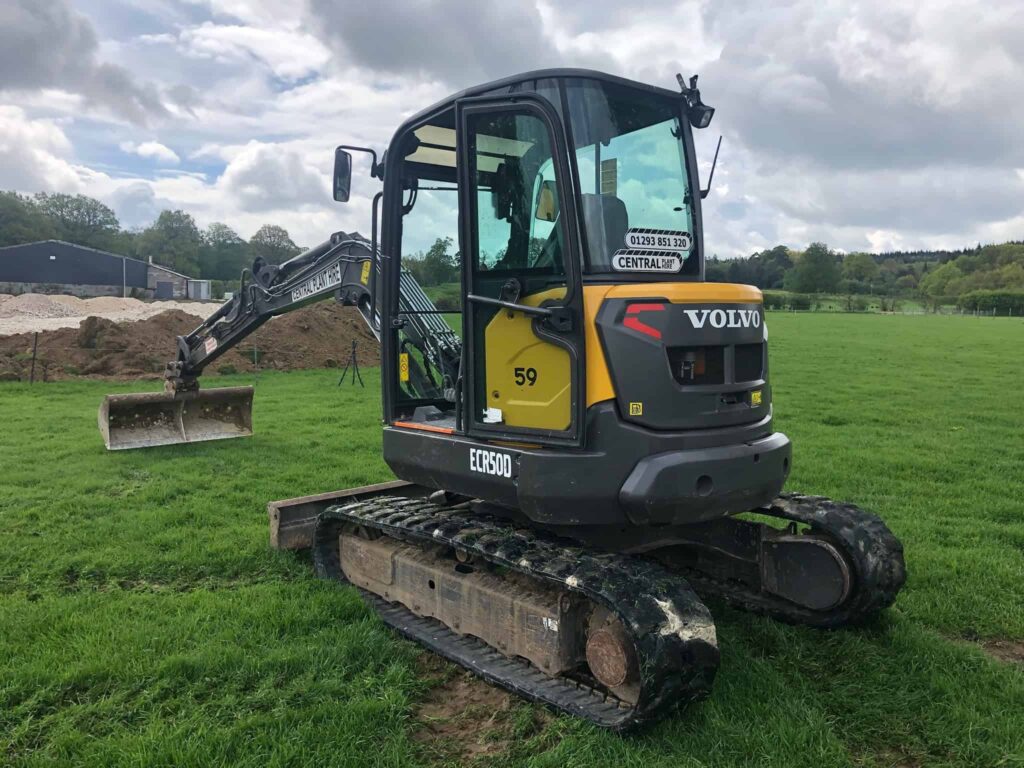
Light track impressions in turf lift out on their own within a few weeks in the growing season. Deeper ruts need the ground breaking up, topsoil putting back and reseeding, which is a half day on a domestic lawn. Individual paving blocks can be lifted and relaid and the joints re-brushed. Tarmac impressions pressed into a soft surface may stay, which is why boarding on a hot day is worth the effort. One distinction to be clear about: you are responsible for the machine while it is on hire to you, and you can either add it to your household or site insurance for the period or take our Loss or Damage Waiver. That covers the machine. It does not cover your driveway, so protecting the surface is worth planning for in advance.
Central Plant Hire is a family business, started in 1988, hiring self-drive diggers, dumpers and attachments across East Sussex, West Sussex and Surrey. Every machine goes out on rubber tracks, and the controls and safe operation get shown to you at handover. If you are still wondering will a mini digger damage my lawn or driveway on your own property, describe the surfaces and the route and we will tell you which machine to take and whether it needs boarding. Get in touch with our team and we will talk it through.
Cracking a sound concrete block is unlikely, because rubber tracks spread the load. The more common issues are blocks tipping at an unrestrained edge and jointing sand pulled out where the machine turns. Cross in a straight line, turn on hardstanding, and check the tracks for trapped stones first.
Yes, but board the route. Wet winter ground on clay compacts and ruts under any load, so boards under the tracks make the difference between a mark that grows out and one that needs digging over.
No. All our diggers and tracked dumpers run on rubber tracks, specifically so they can cross block paving, tarmac and turf without the damage steel would cause.
Only where you are digging. If the turf is coming up anyway, lifting it in strips and stacking it gives you something to relay afterwards and stops it being churned into the spoil. Outside the dig area, leave it down and board over it.
