When a tree comes down, the base of the trunk and the root plate can often stay in the ground. You can use a mini digger to remove tree stumps, and on most garden trees that is the practical way to get them out. A mini digger gets under the root plate and lifts, rather than pulling at what is left of the trunk, so once the lateral roots are cut the stump comes out whole. How straightforward the job is depends on the size of the stump, the species of tree, the ground it is sitting in and the room you have to swing the machine.

The visible stump is the easy part. What holds it in place is the root plate underneath and the laterals running out from it. Conifers such as leylandii sit on a wide but shallow plate that lifts out in one piece once you cut round the edge. Oak, sycamore, ash and established fruit trees anchor deeper. As a yardstick, BS 5837, the British Standard for trees on development sites, works on a root protection radius of twelve times the stem diameter, so a 400mm stump can have roots several metres out. Ground matters too: in the heavy Weald clay across much of Sussex the roots grip hard, where the same stump in sandy soil often rocks free.
The size you need to use a mini digger to remove tree stumps is set by the root plate, not the trunk, and undersizing is what costs you, because a light machine cannot get the purchase to break roots.
All four run on rubber tracks, and the mini diggers have a boom offset so you can dig tight along a wall or fence without repositioning. Each goes out with a quick hitch and a bucket set. Our guide to mini digger buckets covers which does what.
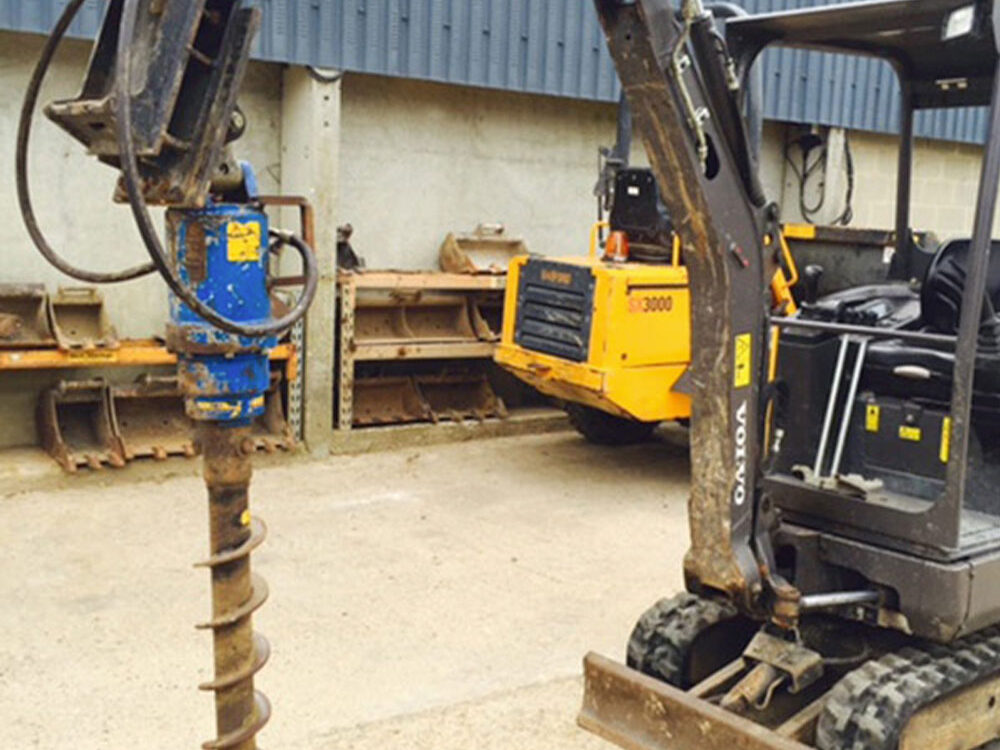
When you use a mini digger to remove tree stumps, dig round rather than down. Open a trench in a ring outside the root plate, wide enough to get the bucket teeth behind the main laterals, and cut those roots one at a time with the leading edge. Thick roots take a series of chopping cuts better than a single heave. Once the laterals are severed on three sides, put the bucket under the plate and rock the stump back and forth until the taproot tears free.
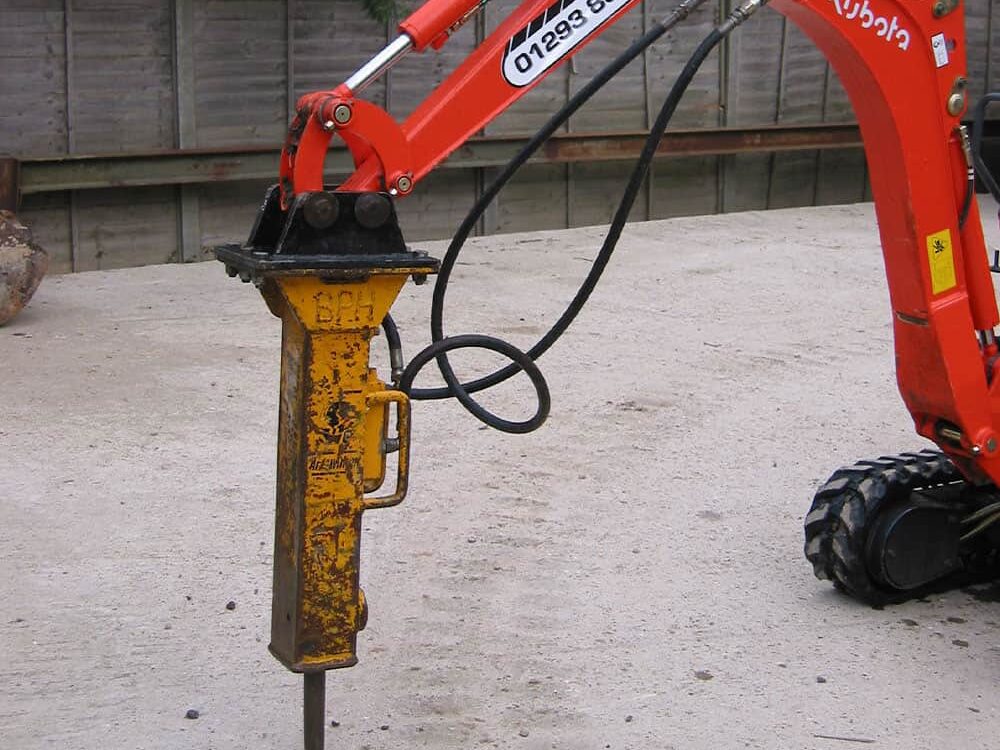
Two habits save time. Leave a metre of trunk standing if the tree is not felled yet, because it gives you something to lever against and beats working a bucket at a flush-cut stump. And do not sling chains off the bucket to drag a stump out: the bucket is not a lifting point, the load goes unpredictable the moment a root lets go, and it is the quickest way to put a machine on its side. A hydraulic breaker is also no use on a stump, though it is worth adding if there is old concrete to take out nearby.
Being detailed about this saves a wasted hire. A digger takes the whole root plate out and leaves a hole, sometimes a big one. A grinder chews the stump down below ground level, leaves the roots in the soil and leaves you chippings. If the stump sits in a lawn you intend to keep and you have no other digging to do, a grinder is tidier.
A digger wins when the ground is being rebuilt anyway. Stripping a garden for a patio, driveway or extension makes the hole part of the dig rather than a problem, and roots left behind by a grinder sit under the new base and rot down over the years. Most people who use a mini digger to remove tree stumps are clearing ground for something else, which is exactly when it is the right machine. Using a digger hire for landscaping projects covers the rest of that work.

Stumps are awkward loads. They are bulky, they hold soil, and a mature root ball is heavier than it looks. A tracked barrow is 750mm wide, carries up to a tonne and tips at 1,300mm, so it takes a root ball out through the same gate the micro digger came in and empties straight into a skip. For bigger clearances the 1 tonne Thwaites skip loader raises its skip to 1,573mm, clearing the side of a builder’s skip. Skips and muck away are not something we supply, though we can usually put you on to a local firm, and whoever carries the material off site should appear on the Environment Agency register.
Stump work puts unusual shock loads through a machine. Wear the seatbelt, keep the door closed and keep everyone else outside the slew radius, because roots under tension spring back several feet when they part. Work on level ground and never dig with the tracks half over the edge of the hole. HSE guidance on excavators and excavation safety covers the ground rules. No licence is needed on private land and we run through the controls on delivery, though most sites want a CPCS card or equivalent as a site rule, which our guide on licences for mini digger hire explains.
Central Plant Hire has been family run since 1988, working out of the yard at Faygate near Horsham and hiring self-drive machines throughout East Sussex, West Sussex and Surrey. No account, no deposit, just ID when the machine arrives, and delivery is charged by area in each direction. If you want to use a mini digger to remove tree stumps on your own ground or on a job you are pricing, tell us the stump size and the access and we will match you a machine. Get in touch with our team and we will sort a delivery date.
It deals with shrub stumps, hedge roots and smaller ornamental trees. At 850kg it is the lightest machine we hire, so it has the least to work against on a substantial root plate, and where the access allows the 1.5 or 3 tonne will get through the same job quicker.
The root plate and the ground decide it more than the trunk does. A wide, deep plate in clay wants the weight of the 3 or 5 tonne behind the bucket, where the same stump in sandy soil may rock free behind something smaller. Send us the stump diameter, the species and how far the crown spread and we will tell you which machine to take.
The dig leaves a hole that needs backfilling and reseeding. The route in and out is a separate question, and rubber tracks are kinder to turf than people assume.
Every machine goes out with a standard bucket set and a quick hitch, so you can fit a narrow bucket for chasing roots and a grading bucket for levelling afterwards. Other sizes come at no extra charge, ditching buckets included.
